



Main Navigation
Main Content
Doctor of Philosophy in Biomedical Engineering
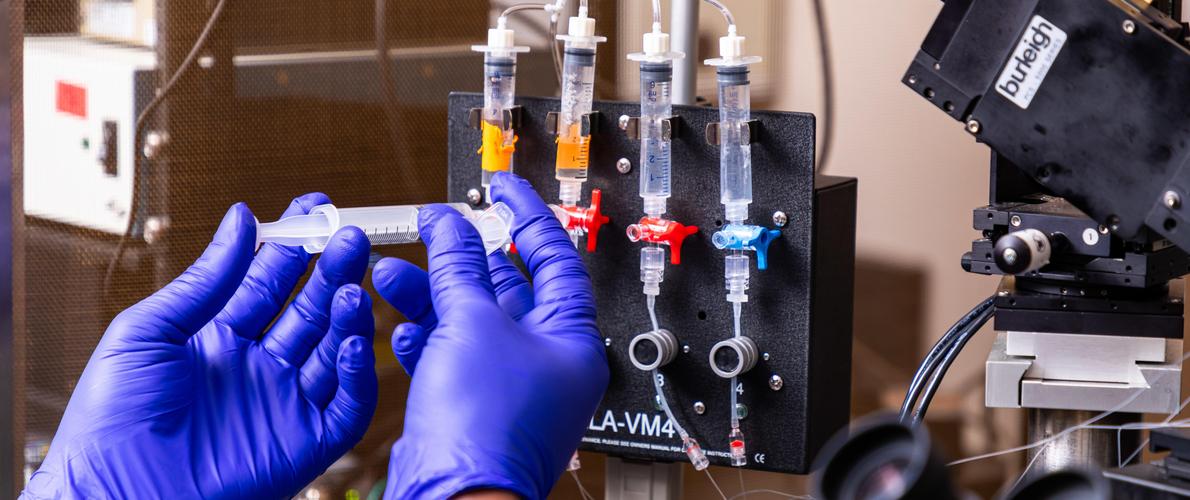
In our program, you receive rigorous training in the foundational concepts and advanced methodologies that drive innovation in biomedical research. You develop the expertise needed to conduct independent, high-impact research and to clearly communicate your findings and research proposals with confidence and precision. This program equips you to advance the field while positioning you for leadership roles in academia, industry, or government.
You can focus your studies in specialized areas such as Biomechanics, Mechanobiology, Biosensors and Medical Embedded Systems, Biophotonics, Medical Imaging and Instrumentation, and Bioinformatics and Computational Biomedical Engineering. Through advanced coursework and immersive research experiences, you build deep expertise in your chosen area while working closely with faculty mentors who support your scholarly and professional growth.
Program Requirements
The Biomedical Engineering Ph.D. combines advanced coursework with independent research. You will complete graduate-level biomedical engineering and mathematics courses before focusing on your dissertation research. During the program, you must pass qualifying and preliminary examinations, develop and defend a research proposal, and complete an original dissertation that contributes new knowledge to the field. The degree concludes with a final oral defense of your research.
Program Structure
The Biomedical Engineering Ph.D. is designed as a research-focused doctoral experience that combines advanced coursework, faculty mentorship and independent research. Early in the program, you will work with a faculty advisor to develop a plan of study and define your research direction. Students complete core graduate coursework before focusing on dissertation research. As part of the program, you will complete qualifying and preliminary examinations and defend a research proposal before advancing to doctoral candidacy and completing your dissertation.
Research Opportunities
Your doctoral research can take many directions depending on your interests and the faculty you work with. Current research areas include biomedical device design and manufacturing, neural engineering, rehabilitation engineering, biomechanics, mechanobiology, medical and surgical robotics, and advanced sensor and electronic systems used in healthcare. These focus areas allow you to engage in research that bridges engineering principles with medical and biological applications, helping to advance technologies used in diagnosis, treatment and patient care.
Facilities and Labs
Your research will be supported by advanced laboratories equipped with specialized tools and technologies for biomedical investigation. These facilities support work in areas such as device manufacturing, microscopy, cell and tissue engineering, neural engineering, biomechanics and robotic systems. Access to these labs allows you to design experiments, test prototypes and explore new solutions that contribute to progress in healthcare technology and biomedical science.
Assistantships and Mentorship
Doctoral students benefit from a collaborative environment where faculty mentorship is a central part of the experience. Research and teaching assistantships help support students financially while providing opportunities to develop professional skills in both research and instruction. Faculty work closely with doctoral students to guide research progress, encourage publication and conference presentations, and prepare graduates for successful careers in academia, industry or healthcare innovation.
Contact Information
Spyros Tragoudas,
Director
Engineering E-202B
1230 Lincoln Dr
Carbondale, IL 62901
618-453-7027
spyros@engr.siu.edu
Shannon Oxendine,
Office Manager
Engineering E-202A
1230 Lincoln Dr
Carbondale, IL 62901
618-536-2364
shannon.oxendine@siu.edu
Career Outcomes
With a Ph.D. in Biomedical Engineering, you can lead research and innovation that improves healthcare. You may design medical devices, develop rehabilitation technologies, create advanced diagnostic tools, or improve surgical and robotic systems. This degree also prepares you to conduct cutting-edge research, advance biomedical discoveries, and teach or mentor future engineers in academic settings.